The Role of Electromagnetic Clutches in Industrial Automation
Oct 30, 2026
Dongguan, Guangdong Oct 29, 2026 (Issuewire.com) - Introduction on the role of Electromagnetic Clutches for automation
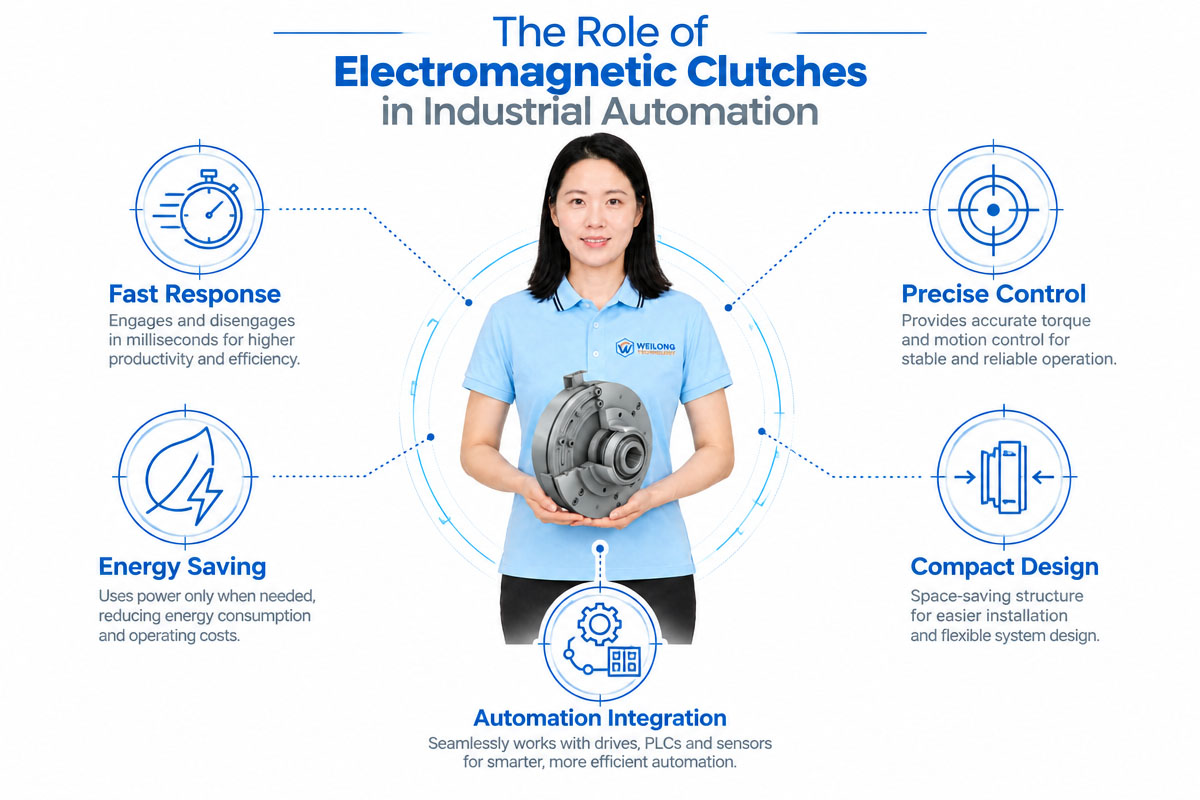
Industrial automation is revolutionizing modern manufacturing by boosting productivity and minimizing manual intervention and improving consistency of the processes. Whether it is automated assembly lines, packaging machines, robotics or any other kind of manufacturing equipment - advanced motion control systems play an essential role in providing exact, repeatable and efficient operation of machines.
The tendency towards smaller and automated industrial equipment boosts the need for reliable electromagnetic components. Selection of the correct clutch technology requires analysis of torque capacity, response time, voltage, duty cycle, thermal performance and lifetime.
Understanding how the electromagnetic clutches operate and in what situations they can bring maximum benefit can help designers of the industrial equipment to build better automation systems.
- What is an electromagnetic clutch?
An electromagnetic clutch is an electromechanical device which uses an electromagnetic field to control the transfer of torque between mechanical components. Power applied to its coil generates a magnetic field which creates an attractive force to energize the clutch mechanism. In the designs intended to work this way, the mechanism unlocks when there is no power.
The exact working principle of electromagnetic clutches depends on its design. Most industrial electromagnetic clutches transfer the torque using friction surfaces, but other technologies of electromagnetic coupling also exist.
Typical electromagnetic clutch consists of the following components:
- Electromagnetic coil:
powered to generate the magnetic field. Clutch plate or armature: transmits mechanical force when the clutch is engaged.
1.2 Rotor and hub
the clutch is connected to rotating machine components.
1.3 Return spring.
Helps to disengage the clutch when the magnetic field is removed, if necessary.
1.4 Housing and bearings.
Provide support to the assembly and ensure the mechanical alignment.
With these components the clutch becomes a tool for controlled power transmission. Electromagnetic clutches can be made to operate rapidly on and off and to be engaged and controlled by electronic systems.
- The Importance of Electromagnetic Clutches in Industrial Automation
Automation equipment has to coordinate motors, shafts, gears, conveyors and other moving parts. Sometimes it is not enough just to turn the motor on and off. A lot of machines require to be able to choose which parts receive power and when the power is delivered to them.
Electromagnetic clutches provide an effective solution. They can be engaged and disengaged electrically.
2.1 Accurate Motion Control
In automated manufacturing timing and positioning are crucial. Electromagnetic clutches can be controlled by electrical signals from programmable logic controllers (PLCs), sensors, relays or other control systems.
This allows machinery to activate the drive mechanism at a particular point in a production cycle. For example, in the packaging machine a clutch may be used to control the movement of the feed roller, while other functions of the machine continue to operate.
This increases the flexibility of coordination of the machine operations.
2.2 Faster Automated Switching
Electromagnetic clutches react very fast to electrical control signals depending on the design, mechanical load and operating conditions.
Fast engagement and disengagement can be useful for equipment used in repetitive operations like indexing, feeding, cutting, sorting or material handling. The engineers have to take into account stopping accuracy and wear along with the response time when selecting a clutch for high speed applications.
2.3 Enhanced Production Efficiency
They can also selectively transmit power. This can reduce the need to stop the whole drive system when a particular mechanism has to stop.
This can help to increase the operating efficiency of certain machines and to simplify their control architectures. The actual energy savings depend on the application, motor configuration, clutch losses and the operating cycle.
2.4 Automatic Control System Integration
A lot of modern industrial machines are a combination of mechanical assemblies and electronic controllers and sensors. Adding electromagnetic clutches to these systems can provide programmable operating sequences and repeatable machine functions.
They are electrically controlled in their operation. This makes them useful in applications where manual engagement would be impractical.
- Major Industrial Applications of Electromagnetic Clutches
Electromagnetic clutches are used in a wide range of industries. Their applicability depends on torque, speed, environmental conditions and working cycle.
3.1 Printing and Packaging Machinery
Precise control of rollers, feed systems, winding mechanisms and material transport is often required in packaging and printing equipment.
Electromagnetic clutches can assist in synchronization of these operations by engaging when power is applied to a given shaft or mechanism. Correct design of the clutch can provide repeatable operation and efficient production cycles in intermittent-duty applications.
3.2 Conveyor & Material Handling Systems
Conveyors move components and finished products from workstation to workstation in automated warehouses and manufacturing facilities.
Electromagnetic clutches allow selective drive control on systems where individual sections of conveyor have to be started, stopped or isolated. The required acceleration, operating speed and expected cycle frequency, load inertia have to be properly sized.
3.3 Transportation Equipment and Automotive
A number of automotive and transportation applications use electromagnetic clutch technology. These include selected compressor drives and auxiliary mechanical systems.
The clutch allows for electrical control of mechanical power transmission in these applications. Reliability, vibration resistance, thermal performance and long-term durability are important in their design.
3.4 Industrial Processing and Textile Machinery
Textile machinery and other processing systems may have to operate in synchronization over several rotating components.
Electromagnetic clutches can provide selective engagement and process coordination in order to make the equipment work according to programmed production demand.
3.5 Specialized OEM Equipment
Custom machinery often has unique space requirements, torque requirements, control interfaces and environmental conditions.
In many such cases the equipment manufacturer and the component supplier have to collaborate in order to select the right electromagnetic clutch. If a standard product cannot satisfy all the demands of the application, then a customized electromechanical solution may be required as well.
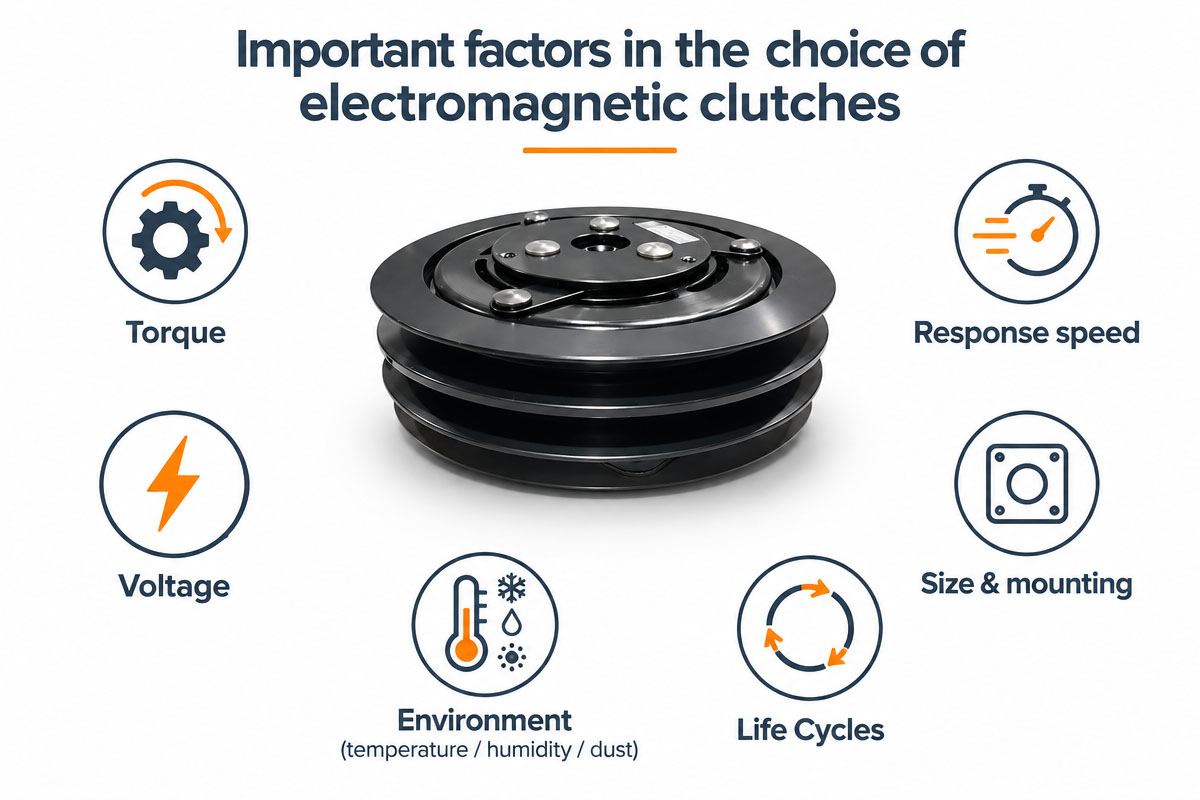
- Important factors in the choice of electromagnetic clutches
Choosing an electromagnetic clutch is not only matching the voltage to the available power supply. The engineers have to check the full mechanical and electrical operating conditions.
4.1 Torque Requirements
One of the most important selection criteria is the torque. The clutch should be able to transmit the required torque in normal operating conditions taking into account starting loads, acceleration, friction losses and other application specific factors.
The engineers have to differentiate between continuous operating torque, peak torque and torque required during engagement.
4.2 Speed and Inertia of Operations
The rotational speed and inertia of the connected parts affect the engagement behavior, heat generation and wear.
For applications with large inertial loads or frequent starts and stops, additional testing and sizing may be required.
4.3 Electrical & Voltage Characteristics
In many industrial systems DC or AC power can be configured in various ways. The coil voltage, current, resistance and power consumption have to be compatible with the control system.
The engineers should also consider switching frequency, electrical noise suppression and temperature effect on the coil performance.
4.4 Duty Cycle & Thermal Performance
Duty cycle is the term used for the length of time a device operates compared to its operating period. Some electromagnetic clutches are designed for intermittent engagement, some can be continuously energized under certain conditions.
Frequent switching and prolonged operation can generate heat. Choosing the correct clutch requires verification of the manufacturer's thermal limitations and real operating profile of the application.
4.5 Mechanical Interface and Installation Space
Factors like available mounting space, shaft size, alignment, fastening method and connection requirements can influence product selection greatly.
It can be attractive for compact machinery to have a smaller assembly, but still it has to satisfy the torque, thermal and durability requirements.
4.6 Service Life and Maintenance
Long term performance is expected to be affected by the number of engagement cycles, operating environment, contamination exposure and maintenance accessibility.
Prototype testing and validation for specific applications allows for detection of potential problems before mass production of critical automation equipment.
- Electromagnetic clutches and Solenoid Actuators in Automation Systems
The two components are similar from the point of view of principle of action but are used to fulfill different tasks.
The main purpose of the electromagnetic clutch is engagement or disengagement of mechanical power transmission. Solenoid actuator is a device that converts electrical energy into linear and limited-angle rotary motion.
In some cases, it is possible to use both kinds of mechanisms in automated machines.
Thus, engineers should consider the main task: whether they need torque transmission or linear displacement, rotation or release of a locking device or any combination of these actions. Choosing components according to the tasks solves the problem of inaptitude and mismatch.
For projects which require non-standard actuator functions, the engineers can cooperate with the solenoid manufacturer and look at alternatives.
- Reason why European & American customers like Weilong
Choosing the electromechanical component supplier for European and American OEMs, it's not enough just to compare the price of a unit. There are several additional criteria which the client may consider.
Weilong Intelligent Technology (Dongguan) Co., Ltd. is engaged in electromagnet clutches since 2007 and supplies custom made electromagnetic components for industrial and commercial applications. Clients working with development of the automated machinery, pay attention to a number of factors.
6.1 Manufacturing capabilities in house
Weilong provides in-house capabilities for metal stamping, tooling development, plastic injection molding, cnc machining, coil winding, assembling and laboratory tests.
The integration of such processes can be useful in manufacturing coordination of the components. It is also can be used for projects requiring custom housing, bobbins, magnetic circuitry or mechanical interface.
6.2 Custom Engineering Solutions
The project requirements of the OEM clients are individual. Client may need to use the component of a certain force or stroke or specific torque curve or voltage and current parameters.
Weilong is engaged in the manufacture of customized electromagnetic components and solenoids, not only the standard units.
This aspect is especially actual in the situation where the client needs to incorporate the electromagnetic component in a special machine mechanism or new product design.
6.3 Experience in supporting OEM development
Since 2007, Weilong accumulated experience in production of solenoids and inductor coils. Such experience can be useful for the clients who consider the development of custom magnetic circuitry, coil configuration, mechanical design and production feasibility.
Clear technical requirements and prototype testing are necessary to check whether proposed solution can fit the conditions of new project.
6.4 Quality control and compliance
Weilong company is ISO 9001 and IATF 16949 certified and complies with applicable requirements such as CE, RoHS and REACH when applicable to particular product and project.
It is the responsibility of the client to guarantee that the scope of certification, product documentation and relevant requirements are in accordance with the target market and end equipment.
6.5 Prototype to Production support
More than the quote 1 is usually needed for successful OEM project. Final result is affected by such factors as technical clarification, evaluation of the sample, design changes and manufacturing process.
However, the best choice should be made basing on technical specifications and quality requirements, project communications and total cost for each particular application.
- The Future Trend of Electromagnetic clutches in Industrial Automation
Robotics, connected manufacturing system, advanced sensing and machine controls continue to advance in automation.
The electromagnetic clutch remains a key component in cases where it is needed to control mechanical power transmission electrically. Further development may include the improvement in thermal properties, compactness, better magnetic circuit, integration with electronics and monitoring of operating conditions.
At the same time not every project in automation needs classical clutch. Some special actuators, servo drives, direct-drive motors, rotary solenoids can be preferable for some applications.
The best way is to evaluate the function and performance requirement as well as the system architecture before choosing the technology.
The cooperation with OEM engineers helps the experienced manufacturers to find practical solutions and avoid design problems in future.
8 Summary
The electromagnetic clutches play an important role in the industrial automation because they allow to control mechanical power transmission that provides switching and coordination of operations of machinery.
The effectiveness of this device is the result of adequate selection of torque capacity, operating speed, electrical characteristics, duty cycle, thermal characteristics and installation design.
The capabilities and manufacturing processes of the component supplier are important for custom OEM projects. Weilong Intelligent Technology offers customized solenoids and inductor coils with in-house manufacturing capabilities and experience in the development of electromagnetic components.
With defined technical requirements and validation of the design via proper tests equipment manufacturers can make good components choices for automation system development.
9 FAQ's on Electromagnetic Clutches in Industrial Automation
- Why are electromagnetic clutches used?
The electromagnetic clutches use the electromagnetic force for engagement and disengagement of the mechanical power transmission. The applications include packaging machinery, printing equipment, conveyor systems, selected automotive systems and industrial automation.
- How do electromagnetic couplings work?
When the clutch coil is energized, the magnetic field appears, and the mechanism of engagement is activated. The engagement is provided in many designs with closure of friction surfaces. Disengagement mechanism depends on the clutch design, it can include a return spring or something else.
- Electromagnetic clutch or solenoid actuator - what is the difference?
The electromagnetic clutch is mostly used for engaging or disengaging of torque transmission between two mechanical parts. Solenoid actuator is mostly designed for linear or limited rotation motion. Both devices can be used for different functions in the same automated machine.
- How to choose the right electromagnetic clutch?
Consider such aspects as the needed torque capacity, speed of operation, inertia, voltage, current, duty cycle, thermal characteristics and dimensions, frequency of engagement and service life.
For heavy loading or frequently engagement, please consult with the supplier.
- What information do you need to provide when requesting a quote?
Technical Drawings (if available). Needed Torque or force. Stroke or angle of rotation. Voltage, current limits, duty cycle, temperature and dimensions. Expected service life. Estimated order quantities. Clear technical specification allows manufacturer to assess feasibility and gives more precise quotation.
- Does Weilong help with applications other than standard electromagnetic clutch applications?
Weilong is specialized in customized solenoids and inductor coils. In case your application needs rotary actuator, linear solenoid or any other electromagnetic mechanism except of traditional clutch, please let us know what you need for initial assessment of feasibility.
About Weilong Intelligent Technology (Dongguan) Co. Ltd.
Founded in 2007, Weilong specializes in solenoids and inductor coils, and offers customized electromagnetic components for OEM applications. The manufacturing capabilities of the company include metal stamping, tooling, plastic injection molding, cnc machining, coil winding, assembly and laboratory tests.
Website: https://smartsolenoid.com/
Media Contact
Weilong Intelligent Technology Co., Ltd.
+86 136 4298 0378
Building 1, No. 2 Jingxiang Road, Dongcheng District, Dongguan City, Guangdong Province, China (Zip code:523128)
Source :Weilong Intelligent Technology Co., Ltd.
This article was originally published by IssueWire. Read the original article here.

YOUR NEWS, OUR NETWORK.
Do you have Great News you want to tell the world?
Be it updates about your business or your community, you can make sure that it’s heard by submitting your story to our network reaching hundreds of news sites across 6 verticals.